The Carnival Prop That Sold America the Dream of Owning a Home

Photo by Photo by Ralph Florent on Unsplash on Unsplash
There are few images more instantly recognizable in American life than the white picket fence. It shows up in presidential speeches, mortgage commercials, and the mental picture most people conjure when they hear the phrase "the American dream." It implies a very specific promise: a safe neighborhood, a stable family, a modest but dignified life. It is, in short, one of the most powerful pieces of visual shorthand the country has ever produced.
So it's more than a little strange to discover that this icon of domestic stability spent its early years as a theatrical prop at traveling carnivals.
Setting the Scene
To understand where the white picket fence came from, you have to go back to the world of traveling entertainment in the eighteenth and nineteenth centuries. Fairs, circuses, and theatrical troupes moved constantly across the American landscape, setting up temporary stages in fields and town squares. They needed scenery that could be assembled quickly, transported cheaply, and read clearly from a distance.
The white picket fence checked every box. It was simple to build from inexpensive lumber, easy to paint, lightweight enough to load onto a wagon, and — crucially — it communicated something immediately legible to any audience. Even from the back row of a makeshift outdoor theater, a white fence said home. It said safety. It said here is a place where decent people live.
The fence wasn't describing reality. It was performing it. That was always the point.
When Developers Came Calling
The leap from carnival backdrop to suburban marketing tool happened gradually through the late nineteenth and early twentieth centuries. As American cities grew dense, loud, and chaotic, a new industry was taking shape on their edges: residential land development. Developers were buying up farmland outside city limits, subdividing it into lots, and trying to convince urban families to take the plunge and move out.
This was a genuinely hard sell. Moving away from the city meant leaving behind familiar neighborhoods, established social networks, and the basic convenience of walking to work. The lots developers were selling often looked like nothing more than muddy fields. They needed imagery that could bridge the gap between what buyers were looking at and what they were supposed to be imagining.
The white picket fence was ready-made for the job. Developers began including it in marketing illustrations, model home displays, and the physical staging of show properties. Plant a white fence around an empty lot and suddenly you weren't selling a patch of dirt — you were selling the idea of a life. The fence implied that the neighborhood was already established, already safe, already the kind of place where families like yours belonged.
It was theatrical stagecraft applied to real estate, and it worked spectacularly.
The Symbol Gets Cemented
The early twentieth century accelerated everything. The rise of mass-circulation magazines like Ladies' Home Journal and Good Housekeeping gave advertisers a national platform to broadcast images of ideal domestic life, and the white picket fence appeared in those images constantly. It framed the perfect house. It surrounded the well-tended garden. It stood at the edge of the lawn where the children played.
These weren't photographs of real homes. They were illustrations — carefully constructed images designed to sell a vision. But repetition has a way of naturalizing things. By the time millions of Americans had seen the same imagery in dozens of magazines over several decades, the white picket fence had stopped feeling like a marketing device and started feeling like a fact of life. Of course that's what a proper home looks like. It always has.
The post-World War II suburban boom drove the final nail. As developers like William Levitt began building entire communities from scratch on Long Island and across the country, the visual vocabulary of the ideal American home got mass-produced along with the houses themselves. Levittown homes came with lawns. Many came with fences. The dream was being manufactured at industrial scale.
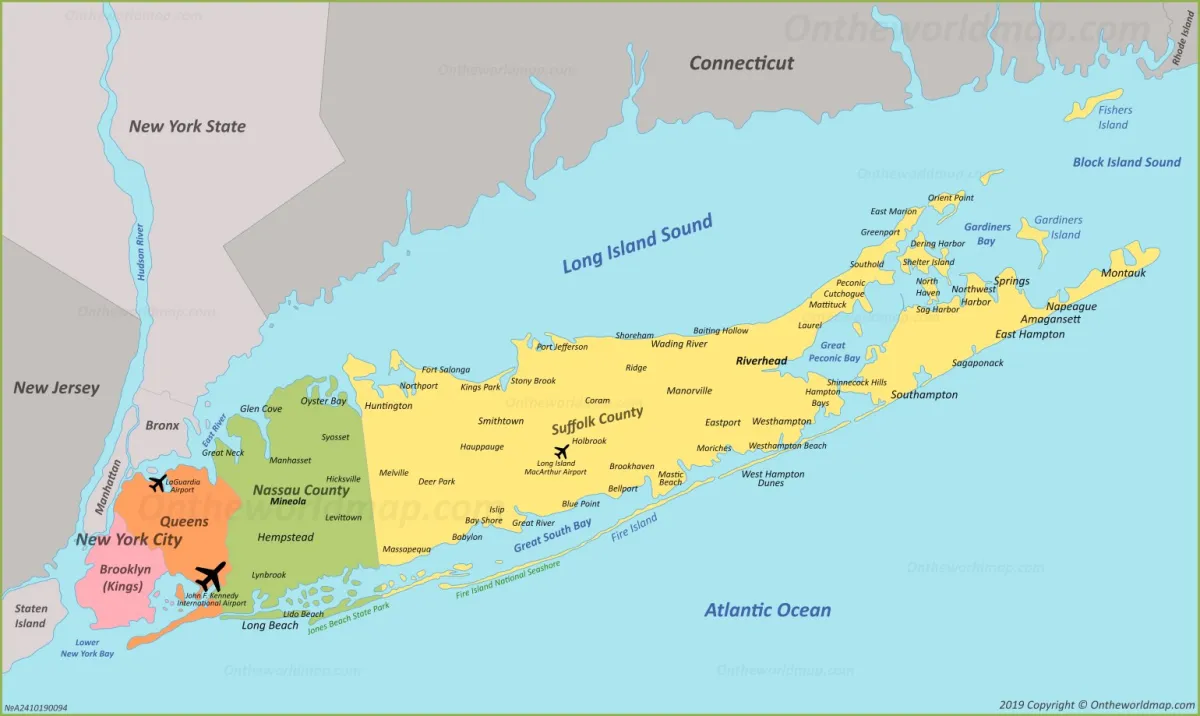 Photo: Long Island, via ontheworldmap.com
What the Fence Was Really Selling
Here's what makes the white picket fence so fascinating as a cultural object: it was never really about the fence. It was about the anxiety underneath it.
The Americans who responded most powerfully to this imagery were often people who had recently arrived in the country, recently moved from rural areas to cities, or recently climbed into the middle class after years of financial precarity. For those people, the fence represented something they desperately wanted and weren't entirely sure they had: legitimacy. Stability. The right to belong somewhere.
Developers and advertisers understood this intuitively, even if they didn't articulate it in those terms. The fence wasn't selling lumber. It was selling reassurance. It told buyers that on the other side of this transaction was a version of themselves that had made it — that was settled, rooted, and safe.
A traveling carnival had used the same prop for the same basic reason: to make an audience believe in a world that didn't quite exist yet.
Still Standing
The white picket fence has taken its share of ironic hits over the decades. Satirists have used it as shorthand for conformity and repression. Suburban sprawl critics have pointed to it as a symbol of everything wrong with how America organized its domestic life. Bruce Springsteen built a career partly on the tension between the promise the fence represents and the reality behind it.
But it hasn't gone anywhere. Americans still build them, still photograph them, still use them in advertising for everything from insurance to ice cream. The image is too deeply embedded to dislodge.
Which means the carnival is still running. The backdrop is still up. And we're still buying tickets.