The Radio Voice That Rearranged Your Furniture
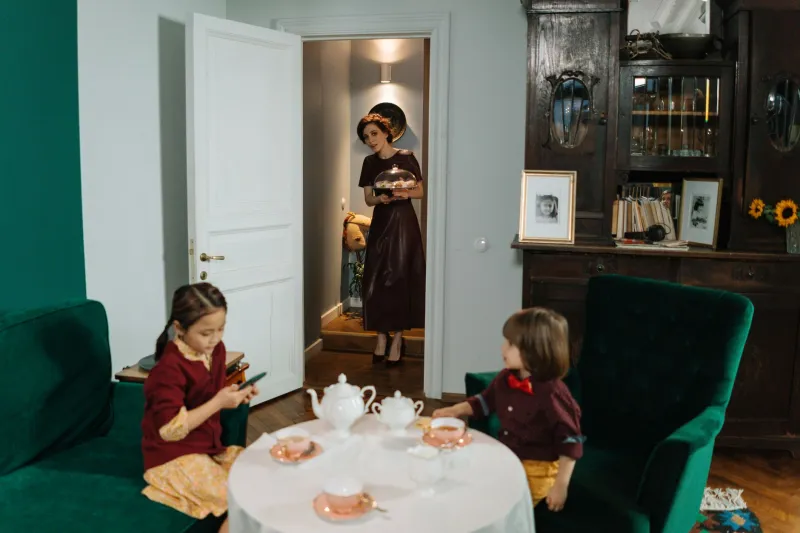
Look at the living room you're sitting in right now — or picture the one you grew up in. There's almost certainly a couch, or a cluster of chairs, arranged in a rough semicircle or direct line facing some kind of screen. It probably feels like the only logical way a room like that could work. Where else would you put things?
But that arrangement isn't logical. It isn't natural. It's a fossil — a behavioral habit preserved in furniture placement, passed from one generation to the next, that traces back to a piece of technology most Americans under forty have never used. Your living room is still arranged around a radio.
Before the Living Room Was a Living Room
For most of American domestic history, the main shared room of a house wasn't designed around entertainment at all. It was a parlor — a formal space meant for receiving guests, displaying the family's social standing, and occasionally hosting ceremonies like funerals or weddings. Furniture was arranged to facilitate conversation: chairs and settees facing each other, a central table, a fireplace as a focal point. The room was about people talking to each other.
The early twentieth century started to shift this. Architectural reformers, influenced by the Arts and Crafts movement, began pushing for less formal domestic spaces — rooms meant for actual daily living rather than performance. The "living room" as a concept (the term was popularized around 1910) was supposed to be comfortable, casual, and functional.
For a brief window, it was. And then radio arrived.
The Cabinet in the Corner That Changed Everything
Commercial radio broadcasting in the United States began in earnest around 1920, with Pittsburgh's KDKA often cited as the first licensed commercial station. Within a few years, it had exploded. By 1930, over twelve million American households owned a radio set. By 1940, that number had nearly tripled.
Early radio sets were not the sleek, compact devices we might imagine. They were large wooden cabinets — furniture in their own right — that produced sound of variable and often frustrating quality. Static was constant. Volume was limited. To hear a broadcast clearly, you needed to be reasonably close to the speaker and ideally facing it.
Families adapted. They moved their chairs. They repositioned their sofas. They arranged themselves in the evening the way an audience arranges itself before a stage — oriented toward the source of the sound, giving it their collective attention. The radio cabinet became the room's new focal point, displacing the fireplace, displacing the conversation circle, displacing the central table.
When Furniture Manufacturers Noticed
At first this was just behavior — families improvising around a new technology. But by the mid-1930s, furniture manufacturers and interior designers had noticed the pattern and started designing around it.
Room layout guides published in women's magazines began recommending that seating be arranged "toward the radio." Furniture sets were marketed with the explicit suggestion that they'd complement a radio cabinet placement. The idea of a room oriented around a single broadcast source — with seating fanned out in front of it — became the default template for what a properly arranged living room looked like.
Architects absorbed it too. New homes built through the late 1930s and into the 1940s increasingly featured living rooms with a single dominant wall — sometimes with a built-in niche or alcove specifically designed to house a radio or, later, a television set. The room's geometry was being shaped by the expectation that everyone in it would be facing the same direction.
Television Inherited the Arrangement
When television arrived in American homes in the late 1940s and early 1950s, it didn't invent a new relationship between furniture and media. It simply stepped into the space that radio had already carved out.
Families didn't need to rethink their room arrangements. The TV went where the radio had been — against the dominant wall, in the focal position — and the sofa and chairs stayed where they'd been moved a generation earlier. The habit was so deeply established that it required no conscious decision. It just was how you set up a living room.
Television manufacturers and interior designers reinforced this without questioning it. Mid-century modern furniture was designed with the TV-facing room in mind. The sectional sofa — which became enormously popular in the 1950s and 60s — was essentially an evolution of the radio-listening arrangement: a large, curved seating surface that kept multiple people oriented toward a single point.
The Screen Changed. The Arrangement Didn't.
Decades passed. The technology kept evolving — color TV, cable, VHS, DVD, flat screens, streaming — but the fundamental geometry of the American living room barely moved. Sofas still face screens. Chairs still cluster around a single focal wall. The room is still, at its core, an audience space.
What's striking is how little any of this was intentional. Nobody convened a committee to decide that American living rooms should be oriented toward broadcast media. It happened organically, one household at a time, as families tried to hear their favorite programs more clearly. Then it got baked into furniture design, into architectural convention, into the unspoken rules of what a "normal" room looks like.
There have been occasional pushbacks. Interior designers periodically argue for conversation-centered arrangements — for pulling furniture away from the wall, for creating spaces that encourage people to look at each other rather than at a screen. It almost never sticks. The radio ghost is too strong.
A Room Shaped by Static
The next time you sink into your couch and flip on the TV, take a second to notice the arrangement. The way you're positioned. The way the room is oriented. You're sitting in a configuration that was settled not by interior designers or architects, but by a family in 1932 trying to hear a baseball game through a wooden cabinet full of static.
They moved their chairs. You're still in that position.
Every ordinary room has an extraordinary backstory — and yours is tuned to a frequency that went silent decades ago.

