The Ancient Weapon Check That Became Wall Street's Favorite Greeting
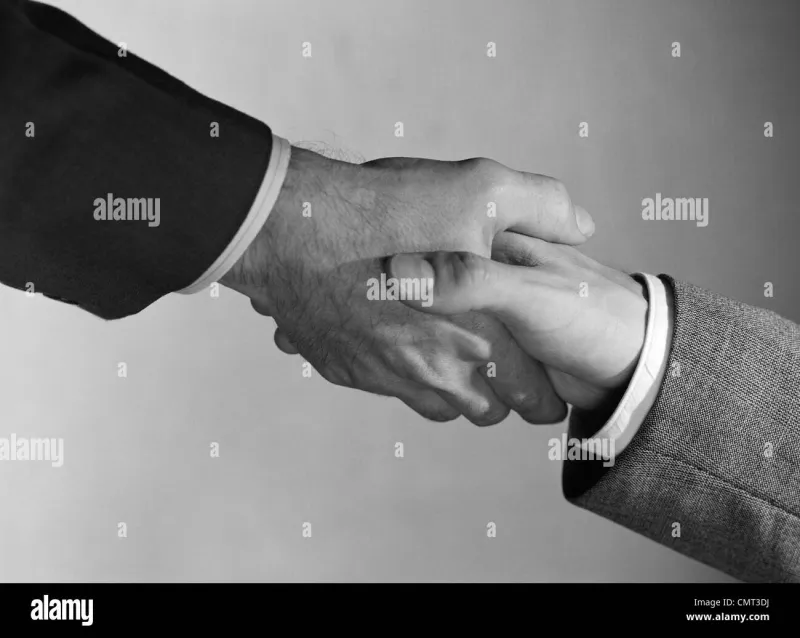
Photo: vintage business handshake black and white historical photograph, via c8.alamy.com
Every day, millions of Americans seal agreements, greet strangers, and close job interviews with the same gesture: a firm, brief clasp of right hands. It takes about two seconds. Nobody questions it. But the handshake has been doing a lot of heavy lifting for a very long time—and the reason it became the universal symbol of a done deal has almost nothing to do with friendliness.
It has everything to do with suspicion, distance, and a 19th-century technology that accidentally made people less sure they could trust each other.
The Original Purpose Was Survival, Not Politeness
The handshake's oldest known function was basically a weapons frisk. In medieval Europe, when two men approached each other—especially strangers—extending your right hand was a way of showing you weren't gripping a sword. Grabbing the other person's hand and shaking it was even better: it made it physically impossible for either party to draw a blade quickly. The gesture was a mutual disarmament, a proof-of-concept that you came in peace.
The Romans had a version of this too, though theirs was more of a forearm grab—checking for daggers hidden up the sleeve. The point was the same. Trust needed to be demonstrated physically, in real time, with your body.
For centuries, the handshake existed mostly as a greeting among social equals. It wasn't yet a deal-sealing ritual. That part came later, pushed along by an unlikely source: the Quakers.
The Religious Sect That Democratized the Gesture
In 17th-century England and colonial America, the Society of Friends—better known as the Quakers—adopted the handshake as their standard greeting precisely because it was egalitarian. At the time, most social interactions were governed by elaborate systems of bowing and hat-tipping that varied depending on the relative status of the people involved. You bowed lower to a nobleman than to a merchant. You removed your hat for a priest but not for a farmer.
The Quakers rejected all of it. They believed in the spiritual equality of all people, and they wanted a greeting that reflected that. The handshake fit perfectly: same gesture, regardless of who you were shaking hands with. It spread through Quaker communities across Pennsylvania and the mid-Atlantic colonies, and because Quakers were deeply embedded in American commerce—they were known for honest dealing and reliable business practices—the gesture gradually attached itself to the world of trade.
By the early 1800s, shaking hands to confirm a business agreement was a common practice in American commercial life. But it was still informal, still regional, still variable in what it actually meant.
Then the telegraph arrived and changed everything.
When Distance Created a Trust Problem
The telegraph networks that spread across the United States after the 1840s were genuinely revolutionary. For the first time in human history, you could send a message across hundreds of miles in minutes rather than days. Business deals that once required face-to-face meetings could now be negotiated by wire. It was faster, cheaper, and seemingly more efficient.
But it created an enormous problem that nobody had fully anticipated: how do you know the person on the other end of the line is who they say they are? How do you confirm that a telegraphed agreement is real? You couldn't see the person. You couldn't read their body language. You couldn't look them in the eye.
Fraud became a serious concern almost immediately. Merchants received telegrams confirming orders that were never placed. Contracts were disputed because one party claimed the message had been garbled or misrepresented. The impersonal nature of the telegraph stripped away all the informal social cues that people had relied on to gauge trustworthiness.
The response, counterintuitively, was to place even greater weight on the moments when parties could meet in person. The handshake—already associated with honest Quaker commerce—became increasingly formalized as the physical capstone of a deal. You might negotiate by telegraph, but you sealed it in person, with a handshake, in front of witnesses if possible.
Business etiquette manuals from the latter half of the 19th century began codifying exactly how this should work: the firmness of the grip, the appropriate duration, the eye contact that should accompany it. What had been a loose social custom was being standardized into a protocol because technology had made everything else less certain.
The Handshake Gets a Rulebook
By the time the telephone arrived in the 1870s and 1880s, the handshake had already been elevated to near-contractual status in American business culture. The new technology created the same trust anxieties as the telegraph—you still couldn't see the other person—but now the ritual of in-person confirmation was even more entrenched.
Corporate culture in the early 20th century doubled down. Etiquette guides, sales training programs, and management literature all treated the handshake as a measurable skill. A weak grip meant weak character. A too-aggressive grip meant something else entirely. The gesture that began as a medieval safety check had become a diagnostic tool for assessing someone's reliability, confidence, and professional worth.
Somewhere along the way, the handshake also became distinctly American in its associations. While European business cultures maintained more formal greeting customs—the bow in Japan, the cheek kiss in France—the American handshake carried the specific mythology of frontier self-reliance and democratic equality. Two people, same gesture, deal done. No paperwork required.
A Gesture That Still Does the Work
For a brief, strange window during the COVID-19 pandemic, it looked like the handshake might finally be displaced. Fist bumps and elbow taps had a moment. Some business commentators declared the handshake dead.
It wasn't. Within a couple of years, the handshake was back in conference rooms, car dealerships, and job interview lobbies across the country, as durable as ever.
That resilience probably shouldn't be surprising. The handshake survived the telegraph, the telephone, email, video calls, and a global pandemic. Every time a new technology creates distance between people, the desire for a physical signal of trust seems to reassert itself.
The medieval knights who extended their empty sword hands were solving the same basic problem as the 19th-century merchants who shook on a deal after a tense telegraphed negotiation. Trust is hard to transmit at a distance. Sometimes you just need to feel it in someone's grip.
That's a pretty long run for something that started as a weapons check.

