The Customer Who Complained One Too Many Times
Summer 1853 at Moon's Lake House in Saratoga Springs, New York. The dining room buzzed with wealthy vacationers seeking respite from the city heat. In the kitchen, George Crum—a chef of mixed Native American and African American heritage—was having the worst day of his career.
A particularly difficult patron kept sending back his French fries, complaining they were too thick, too soggy, not crispy enough. Each time, Crum dutifully prepared a new batch. Each time, the plates returned untouched.
By the fourth rejection, Crum had reached his breaking point. Fine, he thought. You want thin? You want crispy? I'll show you thin and crispy.
The Recipe for Revenge
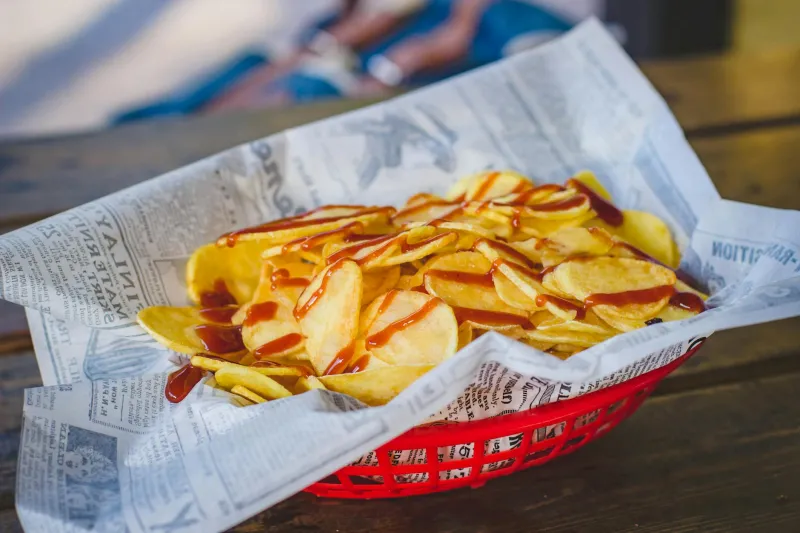
What happened next was part culinary tantrum, part accidental genius. Crum grabbed his sharpest knife and sliced potatoes paper-thin—so thin they were translucent. He dropped them into a vat of bubbling oil, watching them curl and brown to a golden crisp. Then he doused them with an aggressive amount of salt.
This wasn't food preparation—it was kitchen warfare.
The waiter carried the plate to the dining room, probably expecting another rejection. Instead, something unexpected happened. The difficult customer took one bite, then another. Soon, he was asking for more.
Crum had accidentally created what would become known as the "Saratoga Chip"—the world's first potato chip.
From Local Novelty to National Craving
Word spread quickly through the resort town. Guests began requesting "Crum's chips" specifically. The Moon's Lake House started serving them in paper cones as a signature appetizer. By the 1860s, other Saratoga restaurants were copying the recipe, and the chips became synonymous with the region's upscale dining scene.
But Crum never patented his creation. He watched as entrepreneurs began packaging and selling variations of his accidental invention, missing out on what would become one of America's most profitable food innovations.
The first mass-produced potato chips appeared in the 1920s, when Herman Lay began selling them from the back of his car across the South. His company would eventually merge with Frito to become Frito-Lay, now controlling nearly 60% of the American chip market.
The Science of Addiction
What made Crum's angry experiment so irresistible wasn't just the crunch—it was the perfect storm of salt, fat, and carbohydrates that triggers what food scientists call "bliss point." The thin slice maximizes surface area, creating more crispy texture per bite. The high heat caramelizes the potato's natural sugars while the oil carries flavor compounds directly to our taste receptors.
Modern chip manufacturers have turned this accidental discovery into a precise science, using computer models to optimize everything from slice thickness (exactly 1.6 millimeters for maximum crunch) to salt crystal size (fine enough to stick, large enough to provide flavor bursts).
The Billion-Dollar Tantrum
Today, Americans consume over 1.2 billion pounds of potato chips annually—roughly four pounds per person. The industry Crum accidentally launched now generates over $10 billion in yearly revenue, making it larger than the entire music industry.
Ironically, the chips have traveled far from their upscale Saratoga origins. What began as an expensive resort delicacy is now the ultimate democratic snack, equally at home in gas stations and gourmet restaurants.
The Unintended Legacy
George Crum died in 1914, long before his moment of kitchen spite became a cultural phenomenon. He spent his later years running his own restaurant, still serving his famous chips but never quite grasping their revolutionary potential.
His story reminds us that some of history's most transformative innovations emerge not from careful planning, but from pure human emotion—in this case, a chef who was simply fed up with a difficult customer.
The next time you tear open a bag of chips, remember: you're experiencing the delicious aftermath of a 170-year-old kitchen argument, proof that sometimes the best inventions come from our worst moments.