Sunday Afternoon Salvation
In the parlors of 1860s America, children gathered around elaborate game boards decorated with angels, moral lessons, and paths leading either to virtue or damnation. These weren't entertainment—they were salvation tools disguised as fun, designed by earnest Victorian parents who believed that even play time should improve a child's moral character.
The games had names like "The Mansion of Happiness," "The Game of Life," and "Pilgrim's Progress." Players moved wooden pieces along predetermined paths, landing on squares that either rewarded good behavior or punished moral failings. A space marked "Honesty" might advance you several positions, while "Lying" could send you backward or eliminate you entirely.
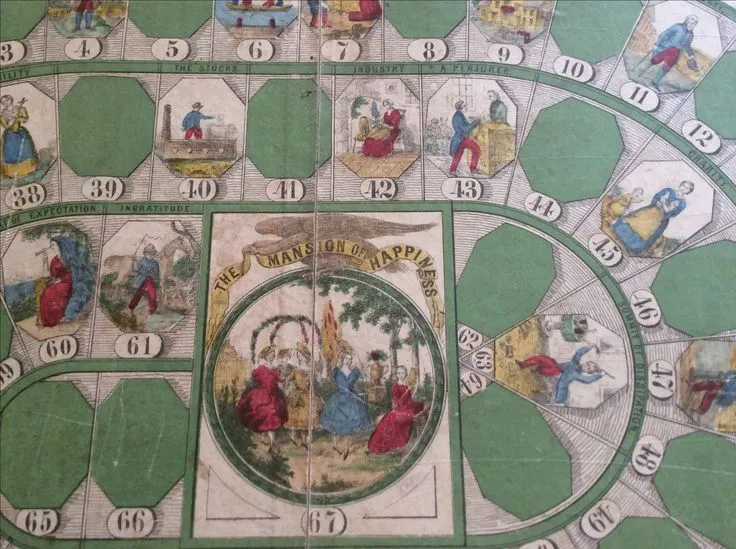 Photo: The Mansion of Happiness, via i.pinimg.com
These morality games represented the first mass-produced board games in American history, and their influence extends far beyond their pious origins. The basic mechanics they established—moving pieces along a board according to dice rolls, collecting rewards, facing penalties—became the foundation for virtually every board game that followed, from Parcheesi to Monopoly to modern classics like Settlers of Catan.
The Moral Imperative of Play
Victorian America took children's moral education seriously, and parents worried constantly about the corrupting influence of idle entertainment. Traditional games like cards and dice were associated with gambling and moral decay, making them unsuitable for Christian households.
But children still needed recreation, and enterprising publishers saw an opportunity to create "improving" games that combined entertainment with moral instruction. The first and most successful of these was "The Mansion of Happiness," published in 1843 by W. & S.B. Ives of Salem, Massachusetts.
 Photo: Salem, Massachusetts, via www.salem.org
The game's board depicted a winding path from "Infancy" to "The Mansion of Happiness," with 67 numbered squares representing various virtues and vices. Players who landed on "Piety," "Honesty," or "Temperance" advanced toward salvation, while those who encountered "Passion," "Ingratitude," or "Cruelty" faced setbacks or elimination.
The rules explicitly stated the game's moral purpose: "Whoever possesses Piety, Honesty, Temperance, Gratitude, Prudence, Truth, Chastity, Sincerity... is entitled to Advance six numbers toward the Mansion of Happiness." This wasn't subtle—it was Sunday school disguised as family fun.
The Business of Virtue
The success of "The Mansion of Happiness" launched an entire industry of morality games. Publishers across New England began producing similar products, each promising to instruct children while they played.
"The Checkered Game of Life," created by Milton Bradley in 1860, refined the formula by adding more sophisticated gameplay mechanics while maintaining the moral framework. Players navigated from "Infancy" to "Happy Old Age," making choices between paths representing different life decisions. The "College" path offered higher rewards but required greater risks, while the "Trade" path provided steadier but more modest advancement.
 Photo: Milton Bradley, via archive.org
Bradley's innovation was recognizing that moral instruction worked better when embedded in engaging gameplay rather than delivered through heavy-handed preaching. His game felt more like entertainment and less like a sermon, helping establish the principle that successful games needed to be fun first and educational second.
The commercial success of these games was remarkable. "The Checkered Game of Life" became one of the best-selling games of the 19th century, establishing Milton Bradley as a major publisher and proving that Americans would pay good money for wholesome family entertainment.
The Secular Revolution
By the 1880s, American attitudes toward leisure were beginning to shift. The strict moral framework that had dominated Victorian culture was giving way to a more relaxed approach to entertainment. Publishers began creating games that emphasized fun over moral instruction, though they retained the basic mechanics established by their pious predecessors.
The transition wasn't immediate or complete. Many games continued to include moral elements well into the 20th century, but these became secondary to pure entertainment value. Publishers discovered that games could be commercially successful without explicit moral messages, as long as they provided engaging gameplay.
This shift coincided with America's growing prosperity and urbanization. Middle-class families had more leisure time and disposable income, creating a larger market for entertainment products. The board game industry responded by developing more sophisticated and varied offerings, moving away from simple morality tales toward games that explored themes like business success, adventure, and competition.
The Template That Conquered the World
The basic game structure established by Victorian morality games—a board with a predetermined path, movement determined by chance, rewards and penalties based on where players land—became the standard template for American board games. This format proved so successful and intuitive that it spread worldwide, influencing game design across cultures and centuries.
Modern games like Monopoly, Trivial Pursuit, and even video games like Mario Party follow the same basic principles established by "The Mansion of Happiness" and "The Checkered Game of Life." Players move pieces along a board, face random events, collect rewards, and compete to reach a winning condition first.
Even games that seem completely different often incorporate these Victorian-era innovations. The concept of advancement through virtuous behavior evolved into modern games' achievement systems and progression mechanics. The moral choice between different paths became the foundation for strategy games where players must choose between competing objectives.
From Salvation to Entertainment
The transformation of board games from moral instruction tools to pure entertainment reflects broader changes in American culture. The Victorian belief that all activities should serve a higher moral purpose gave way to the modern acceptance of entertainment for its own sake.
Yet the influence of those early morality games persists in subtle ways. Modern board games still often include themes of personal improvement, goal achievement, and consequences for choices—echoes of their Victorian ancestors' moral framework, stripped of explicit religious content but retaining the underlying structure of reward and punishment.
Today's billion-dollar board game industry owes its existence to earnest Victorian parents who wanted to make sure their children learned proper values while having fun. Those long-forgotten morality games established the mechanical and commercial foundations that still govern how Americans play, proving that even the most pious intentions can have unexpectedly lasting cultural impact.
The next time you roll dice to move around a board, collect rewards, or face penalties based on chance, remember: you're participating in a tradition that began as moral education for Victorian children, transformed by generations of game designers who gradually replaced salvation with entertainment while keeping the underlying structure intact.