One Night of Fire, a Century of Cul-de-Sacs: How the Great Chicago Fire Built the American Suburb
One Night of Fire, a Century of Cul-de-Sacs: How the Great Chicago Fire Built the American Suburb
On the night of October 8, 1871, a fire started somewhere on the southwest side of Chicago — the exact cause still isn't settled, despite the enduring legend about Mrs. O'Leary's cow — and by the time it burned out two days later, it had consumed roughly three and a half square miles of the city. More than 17,000 buildings were gone. Around 100,000 people were homeless. The financial damage, in today's dollars, would run into the billions.
It was one of the most destructive urban disasters in American history. It was also, in a roundabout way that no one planned and almost no one noticed at the time, one of the most consequential moments in the story of how Americans came to live where and how they live.
The connection runs through a construction method, a housing crisis, and about 80 years of slow-building momentum — and it ends in the suburbs where millions of Americans grew up.
The Building Technique That Made Chicago Possible
To understand what the fire changed, you have to understand what existed before it. Chicago in 1871 was a young city that had grown with almost reckless speed. It had gone from a small trading post to a major American metropolis in roughly four decades, and a lot of that growth was made possible by a construction innovation called balloon-frame building.
Before balloon framing, wood construction meant heavy timber — thick beams joined by mortise-and-tenon joints, requiring skilled carpenters and significant time. It was sturdy, but it was slow and expensive. Balloon framing, which emerged in Chicago in the 1830s and 1840s, replaced all of that with a lightweight skeleton of standardized dimensional lumber — the 2x4s and 2x6s that still form the bones of most American homes today — held together with machine-cut nails rather than hand-fitted joints.
The result was a building system that almost anyone could learn quickly, used cheap and widely available materials, and could go up in a fraction of the time of traditional construction. Critics called it flimsy — the "balloon" name was partly a joke, implying the buildings might float away. But it worked, and it spread.
Chicago was largely built with balloon-frame construction. Which meant that when the fire came, it had an enormous amount of dry, lightweight wood to consume.
The Rebuild That Changed Everything
The morning after the fire, Chicago faced a staggering logistical problem: it needed to house tens of thousands of people, and it needed to do it fast. There was no realistic option for slow, deliberate reconstruction. The city had to rebuild at a pace that had never really been attempted before.
Balloon-frame construction was the obvious answer — not because anyone was making a grand architectural statement, but because it was fast and cheap and the materials were available. The railroads that ran into Chicago could deliver standardized lumber from the Great Lakes timber industry in volume. Builders who knew the method were already in the city. Within months, neighborhoods were going back up.
The rebuild also attracted architects and engineers from across the country who were drawn by the scale of the opportunity. Chicago became, in the decades after the fire, a genuine laboratory for construction innovation. The city that rose from the ashes was more systematically built than the one that had burned — and the lessons learned there, about how to construct quickly and affordably at scale, spread outward.
The Long Fuse to the Suburbs
Here's where the timeline stretches in a way that's easy to miss. The direct line from the 1871 fire to the post-World War II suburban explosion isn't a straight shot — it's more like a slow accumulation of changed assumptions and refined techniques.
Balloon-frame construction, refined through Chicago's rebuild and subsequent urban growth, became the default American building method through the late 19th and early 20th centuries. By the time William Levitt was building Levittown in New York in the late 1940s — the development that became shorthand for the entire postwar suburban phenomenon — he was working with a construction system whose basic logic had been stress-tested for nearly a century.
Levitt's innovation was applying industrial efficiency to that system: standardized floor plans, assembly-line sequencing, specialized crews who did one task across dozens of houses before moving on. He could build a house in a day. The affordability that made Levittown possible, and that made homeownership accessible to millions of returning veterans and their families, depended entirely on the cheap, fast construction that balloon framing made possible.
Take away the construction revolution accelerated by Chicago's rebuild, and the postwar suburb as we know it doesn't exist — or at least doesn't exist at that scale, at that price, for that many people.
The Neighborhood You Grew Up In
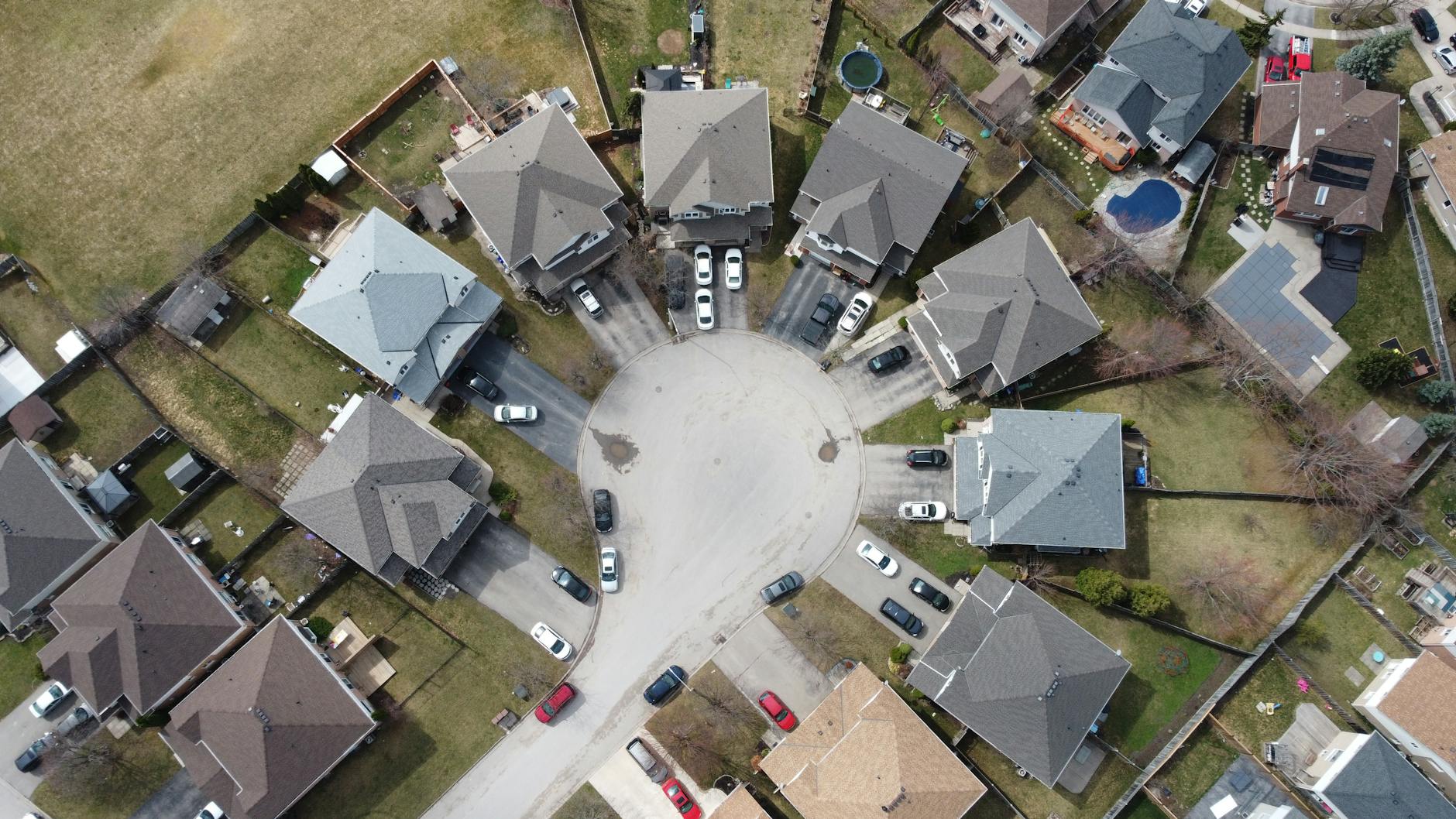
Drive through almost any American suburb built between 1945 and 1975 and you're looking at the downstream consequences of that October night in 1871. The ranch houses, the split-levels, the quiet streets with the sidewalks and the attached garages — they're all built on the same structural logic that Chicago refined in the years after the fire.
Nobody planned it that way. The fire was a catastrophe, not a design session. The builders who showed up to reconstruct Chicago weren't thinking about what American neighborhoods would look like a hundred years later. They were just trying to put roofs over people's heads before winter.
But that's often how the built environment works. One crisis demands a fast solution. The fast solution becomes the standard. The standard becomes invisible. And eventually, millions of people grow up in homes that trace their bones back to a disaster nobody wanted — and a rebuilding effort nobody fully remembers.